

The media kit from a company perspective:
f a company is interested in working with bloggers, they need to allocate their budget depending on achievable goals. This means that the company has to calculate how many consumers it can potentially reach with a blog post and whether the investment is worthwhile. We bloggers usually see this less mathematically and keep the added value for the reader in the foreground. That’s perfectly fine too, but as a company, it’s important to know what’s possible in advance of many emails.
The great thing about the Media Kit is that you can not only store numbers, but also important information about you and your blog. Because it is often important for a company that the blog fits its own brand. The company gets a first impression of you and your blog through your blog. In the Media Kit you can also convince yourself and see a company as a customer and ‘sell’ your blog to them.
The media kit from a blogger’s point of view:
As a blogger, the media kit is insanely useful. If you receive a non-specific cooperation request and the company doesn’t really know what kind of cooperation you want to do, an e-mail with your media kit is sufficient and the company can be inspired by the cooperation example and be influenced by a list of possible cooperations. If it is a very individual cooperation, this can also be arranged without a media kit, but in many cases it is much easier for a company to know what is possible and what a blogger does not want to do.
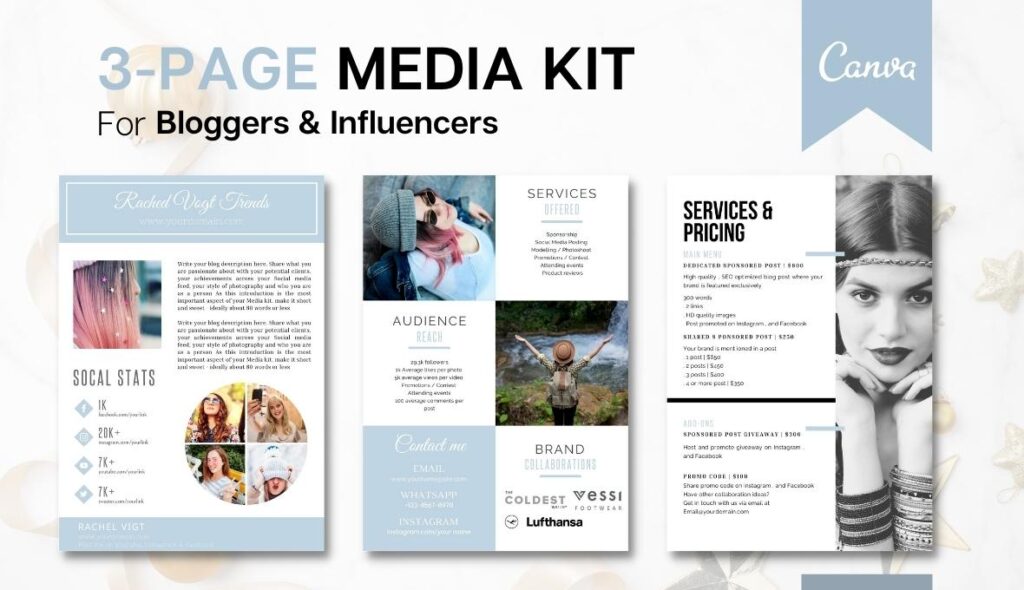
What comes in the media kit?
1. Introducing yourself is important so that the company can get a picture of you as a person. Here you should give an insight into what you do professionally and what motivates you for blogging.
2. Presenting your blog is all about the topics you write about and what your readership is like. Are there more women than men, young or old, where do your readers live? You should answer all these questions at the presentation.
3. This is more about the hard facts. Especially if your blog is still young, you may feel uncomfortable disclosing views that are not yet so high. My tip: stay honest with yourself and others. No matter what the number, if you’ve previously delivered a nice piece of text and your example work is fantastic at 6. that will be far more significant than the number here. Nevertheless, you should not simply leave out the numbers, because companies need the information on your reach to see whether cooperation is worthwhile for them.
4. As always, quality over quantity applies to social media channels. Prioritize 3-4 networks you’re actually active on instead of naming every network with even 3 followers.
5. There are many opportunities for cooperation, but not every blogger wants to enter into every cooperation. To provide a small overview, I have included a small list of possibilities. In my media kit, you will see that I didn’t record them all and you can do the same. Only name the options that you are really comfortable with.
6. Pictures, pictures, pictures! Here you can show what you can do. Find your favorite posts and link the images directly to the relevant post. The company gets a visual insight into your visual language and can continue reading the article if you are interested.
7. As in the CV, when naming past cooperation partners, a lot of experience is good, but if you name 50 companies here, it seems (sorry for using this idiom) as if you were doing it with everyone. Pick out the cooperation partners with whom you had really good cooperation.
Now you know what should go in a media kit, but what’s important in addition to the content: